Our Vision: One Transplant for Life
With the introduction of the “companion prognostics” approach, PIRCHE is setting a new standard in transplant medicine.
A shift from reactive to proactive that bridges the gap between prediction and monitoring.


Why combine PIRCHE with dd-cfDNA surveillance?
Integrating predictive PIRCHE immunogenicity scores with real-time dd-cfDNA injury detection transforms transplant care from reactive damage control to proactive, precision surveillance.
PIRCHE enables clinicians to anticipate alloimmune risk before the transplantation, supporting the goal that every patient’s first transplant becomes their only transplant.
Click here to download TxPredictor - The Handbook.
Intergrating indirect T-cell recognition with B-cell data with a comprehensive, 360° assessment of immunological risk
Validated utility across all solid organ and stem cell graft types
Efficient work on the intuitive TxPredictor platform
200+ peer reviewed publications on the medical evidence of PIRCHE
1M+ real world transplant cases
PIRCHE can be combined with any dd-cfDNA test on the market.
By pairing molecular immunogenicity prediction (PIRCHE) with dynamic graft injury biomarkers (dd-cfDNA), clinicians can:
This combined strategy elevates transplant monitoring to a future ready, precision medicine standard.
See the Press Release on our collaboration with Natera.
Take advantage of the economic benefits of induction therapy, immunosuppression, and lower readmission rates
Intervene precisely before irreversible graft damage occurs
Personalize surveillance intensity by risk stratification
Extend long term graft survival through informed, data driven decisions
Evaluate early signals of alloimmune activation
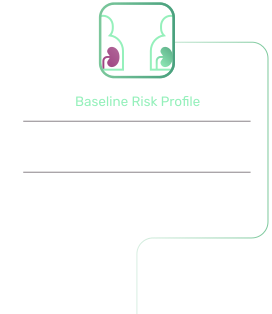
Step 1: Baseline Assessment of Risk Profile
Establish the PIRCHE Score before or at the time of transplantation with regard to the specified donor-recipient match to categorize the patient’s baseline immune susceptibility.
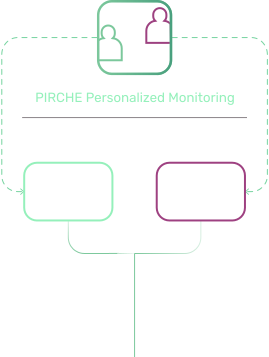
Step 2: Stratified Monitoring
Align dd-cfDNA screening frequency with the patient’s immunological risk profile.
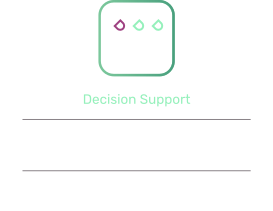
Step 3: Data-Driven Action
If dd-cfDNA levels rise, clinicians utilize the baseline PIRCHE score alongside other advanced TxPredictor modules (such as OPM, RAMP or Tmem) to determine whether an immediate biopsy is required or if a targeted adjustment in immunosuppression is appropriate.
By bundling PIRCHE and dd-cfDNA, transplant centers move beyond generalized protocols to a new standard of precision medicine - minimizing risk while maximizing graft half-life.
Latest research highlights the potential of PIRCHE in tailoring immunosuppression and advancing allogeneic immunotherapy development in oncology and autoimmunity.
Reach out to us to explore how you can leverage PIRCHE in your projects and clinical practise.
Click here to download TxPredictor - The Handbook.
Transplant Medicine
Compatibility between a recipient and a donor is at the core of success in solid-organ and bone marrow transplantation.
PIRCHE focuses on predicting how well the recipient's immune system will recognize and respond to the donor organ based on HLA epitopes.
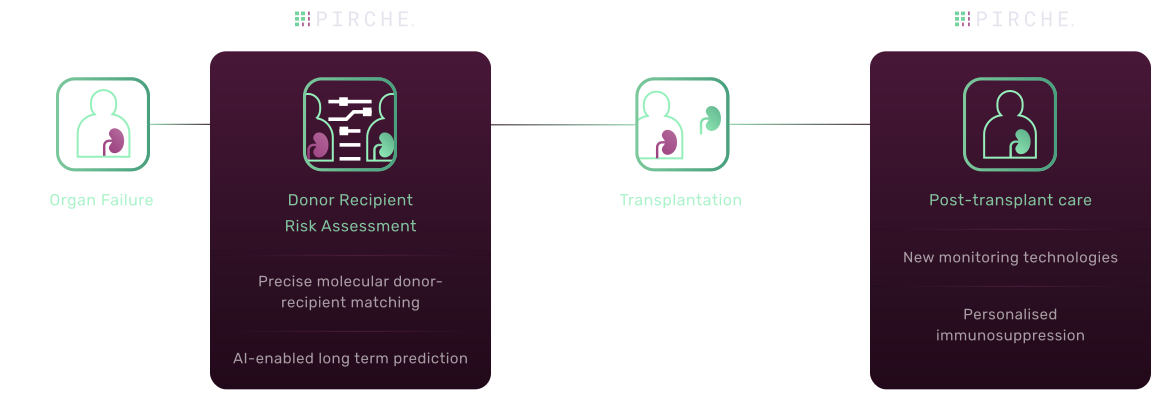


Minimize Graft versus Host Disease

Guiding immunosuppressive therapy

Optimizing biomarker monitoring

Donor selection
Technology
TxPredictor
Our state-of-the-art platform, TxPredictor, merges genetic typing with real-time, AI-supported immunological simulations, enabling clinicians to make precise, personalized medical decisions.

The Pirche TxPredictor platform uses T and B cell epitope predictors, allowing clinicians and laboratories to interact with their patient’s tissue compatibility data like never before. Running on a high-performance cloud infrastructure, it combines real time analysis with clear user interfaces.
By leveraging standard clinical lab results and seamlessly integrating with leading laboratory IT systems, we provide a plug-and-play solution that transforms patient care.
Highlights & features
Absolute and relative immunologic risk quantification
Low resolution HLA typing support
Real time & cloud based
Low turnaround time
Integration with major HLA vendors’ software
No maintenance
Cell Therapy
PIRCHE epitope matching reduces the risk of immune rejection, by identifying donors whose cells are less likely to be recognised as foreign. This is crucial in allogeneic cell therapy where mismatched donor cells can lead to immune-mediated destruction of the therapeutic cells.


Pirche can help

Identify optimal
‘off-the-shelf’ therapy

Minimize Graft versus Host Disease

Optimize therapy efficacy and safety
Our partners